
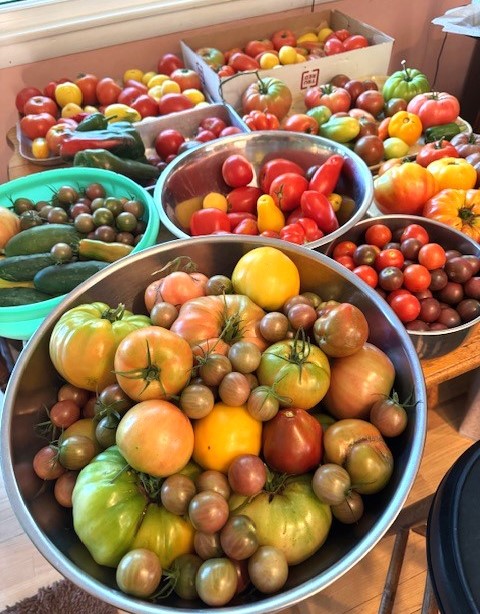
How many different tomato trellises and other growing systems are there? The answer is lots and lots. As we like indeterminate heirlooms, trellising is imperative. I tried something different this year. I did almost no pruning. Mostly, I pruned leaves that could make ground contact and straggler stems that got outside the tied-down stems.
I tied most of the stems to the bamboo poles and T-posts I use for the trellis. There were some negatives to this approach, but the yields are fantastic and the quality of the tomatoes is excellent.
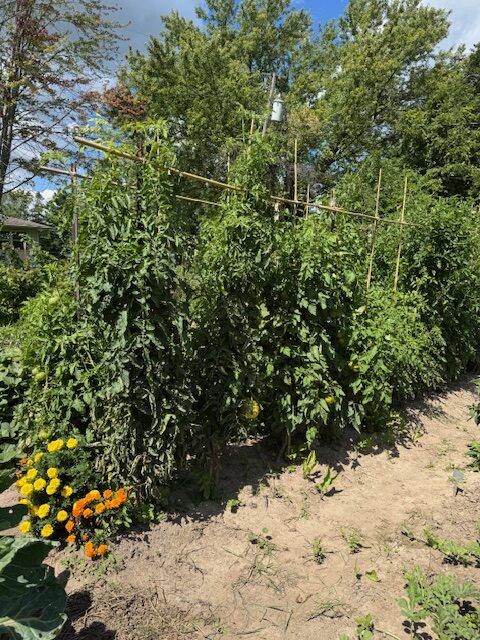
Tomato Bed
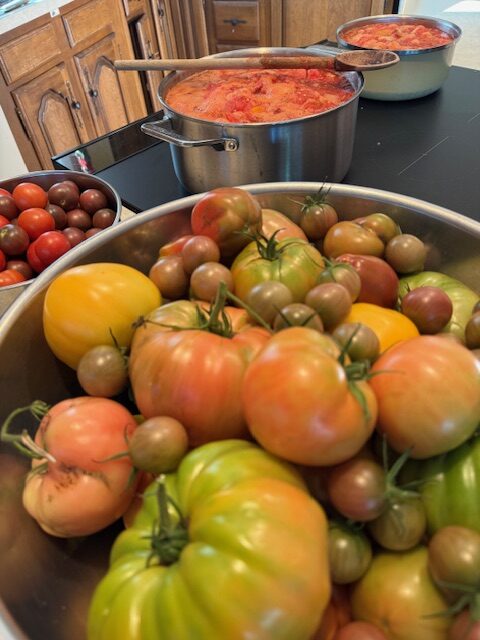
Tomatoes and Sauce
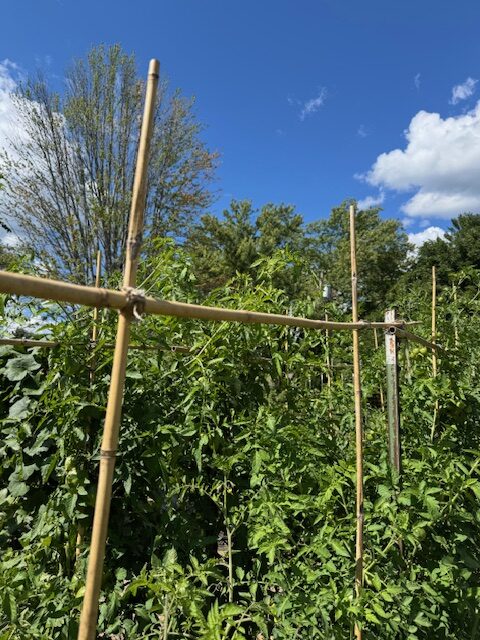
Weak Support
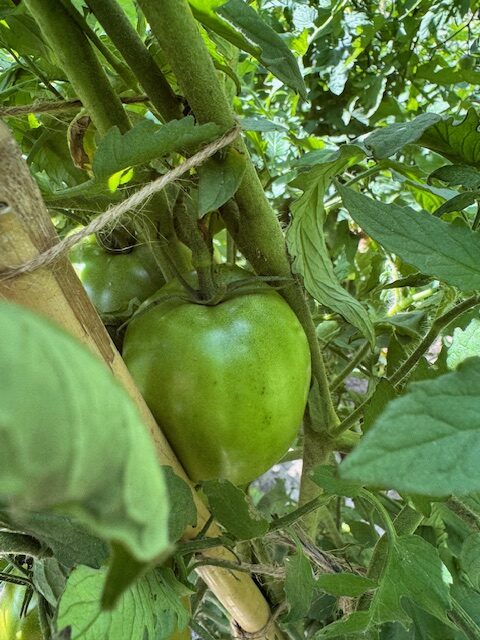
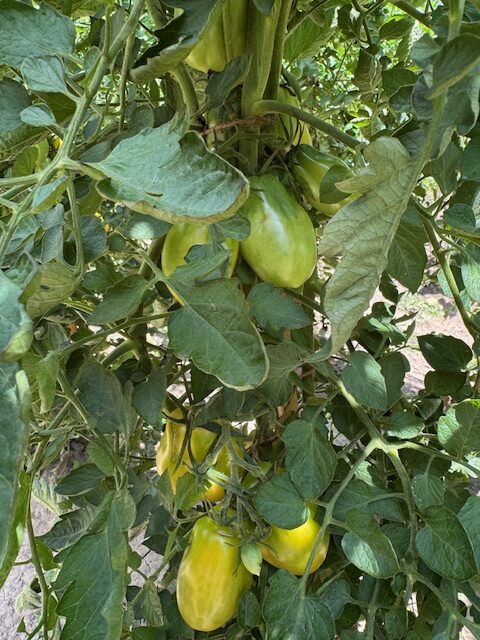
Early in the season, I followed a rigorous spray routine using copper sulfate, resulting in no loss of foliage covering the lower-hanging tomatoes. Without spraying, leaf blight would have destroyed a lot of the crop.
I’m already looking forward to next year when I’ll put some new ideas into practice. Growing a lot of different food plants offers many challenges, but you get to solve the problem and become a better gardener. There is always more to learn regarding growing techniques.
Growing tomatoes is considered a competitive sport by some. A storyteller, I have a story about that.
I grew no tomatoes this year, but have done so for more than 50 years and know all too well the pseudo problem of too many tomatoes (too many cucumbers, too many zucchini, etc.)
My favorite way of trellising tomatoes (and other plants such as peas, cucumbers, etc.) is to make “tubes” of concrete reinforcing wire (the wire with ~4″ squares).
Cut lengths of just over 6′, leaving long cut wires on the ends. Then roll this piece into a tube and use the cut lengths of wire to fasten the tube together. Though they will get rusty, these tubes can then be used for decades. After 25 years in this location, my original tubes are still going strong.
The only downside is that storage in a corner of the yard and into our woods between growing seasons is the only real option as these tube cages are bulky. It is also a bit of a pain to move them out of the garden for cleaning, and tillage and then back in after planting, but compared to using bamboo, or other poles and string, why this is but a small inconvenience and is much, much less of a bother.
Instead of bamboo, wood, or even stout fence stakes, years ago, I invested in 20′ lengths of 1/2″ rebar, which I cut into 5′ lengths for both use and for easier transport in the parking lot at the local Home Depot. The 20′ lengths were a bit cheaper than the shorter lengths.
I use these indestructible posts to erect temporary fences with the 6′ lengths of concrete reinforcing wire as I have a severe deer problem, and as general purpose garden stakes.